Splinter Theory: What Japanese Skaters Actually Learn When a Board Snaps Under Their Feet
Every American skater knows the feeling. You stomp a trick wrong, hear that hollow crack, and watch your deck fold in half. The first thought isn't philosophical—it's financial. That's another sixty, seventy, maybe eighty bucks gone before you even hit the parking lot. You bag the splinters, text your homie something unprintable, and start mentally budgeting for a new setup.
In Japan, the script plays out differently.
Not because Japanese skaters are made of money, or because their boards are somehow indestructible. They break just as often. The difference is what happens in the thirty seconds after the snap—what questions get asked, what information gets extracted, and what that shattered maple actually means for the next session.
There's a concept in Japanese craft culture sometimes loosely translated as yaburi—a deliberate breaking, a rupture that reveals. It shows up in everything from ceramics to martial arts. The idea isn't that breaking something is good. It's that breaking something tells you something, if you're paying attention when it happens.
Japanese skaters, especially those coming up through the country's tight-knit street communities in Tokyo, Osaka, and Nagoya, have quietly absorbed this logic into how they approach progression.
The Break Doesn't Lie
Here's the thing about a snapped board: it's one of the most honest pieces of feedback you'll ever get on a trick.
Where did it break? Dead center under your back foot on a flat-ground trick usually means you were landing with all your weight compressed straight down—no pop absorption, no bend in the knees. A snap near the nose on a gap means your weight was forward too early. A clean break across the middle of a handrail attempt? That's commitment data. You either over-committed to a spot your body wasn't ready for, or you hesitated at the worst possible moment and landed off-center with nowhere to redirect the force.
Japanese skaters treat this like a reading exercise. The break pattern is a sentence. Most American skaters throw the board away before they finish reading it.
Tokyo-based riders who've been skating the city's dense, obstacle-rich street terrain for years will often talk about snapped boards in the same breath as video review—both are just ways of seeing what you can't see in real time. One is digital, one is physical, but they're serving the same function: slowing down the moment so you can extract something useful from it.
Why We're Wired to See Failure Instead of Feedback
American skate culture has a complicated relationship with broken gear. On one hand, there's a long tradition of skating boards until they're completely waterlogged, razor-tailed, and held together by habit and stubbornness. On the other hand, when a board actually snaps mid-session—especially on a trick you've been building toward—the cultural response is almost universally to treat it as a setback.
Social media hasn't helped. The clips that circulate are the makes. The broken boards stay off-camera. Which means we've collectively trained ourselves to see destruction as the opposite of progress, when sometimes it's the most direct path toward it.
There's also the cost factor, which is real and shouldn't be dismissed. Skateboarding is expensive. A snapped deck mid-session in a city where the nearest shop is forty minutes away isn't just a bummer—it ends your day. That financial sting conditions a fear response around breaking gear that goes deeper than just money. It becomes psychological. You start pulling back on tricks not because you're not ready, but because you're protecting the equipment.
Japanese skaters aren't immune to this. But there's a cultural emphasis on separating the emotional reaction from the analytical one. Feel the frustration—then set it down and look at what the board is showing you.
Commitment Level Is Written in the Wood
One of the most uncomfortable truths that the yaburi mindset surfaces is this: a lot of broken boards are broken by hesitation, not by too much aggression.
When you half-commit to a trick—when your body starts going and your brain pumps the brakes at the last second—the force distribution on your board becomes chaotic. You land off-axis, weight in the wrong place, with none of the structural logic that a clean, committed landing would carry. That's when boards snap. Not always from going too hard, but from going halfway.
Japanese coaches and older skaters in the community use this as a teaching moment rather than a consolation. If you broke your board on that trick, they'll ask, where were you when it landed? Were you over it? Were you already bailing? The answer is usually visible in the break.
This reframes the conversation around commitment in a way that's genuinely useful. It's not about being reckless or throwing yourself at things without preparation. It's about identifying the specific moment where mental hesitation becomes physical consequence—and using the broken board as proof of where that line actually sits for you.
Building a Different Relationship With Destruction
So what does this actually look like in practice for an American skater trying to adopt this lens?
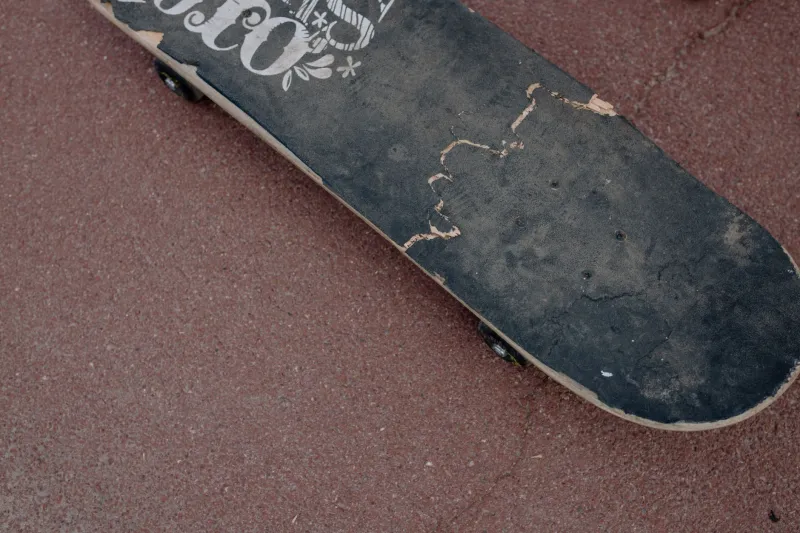
It starts with slowing down the post-break reaction. Before you toss the deck or kick it across the concrete, look at it. Where did it go? Was the break clean or jagged? What were you doing when it happened—landing, bailing, or something in between? Give yourself sixty seconds to read the receipt before you close the tab.
Keep a session log if you're into that kind of thing. Note what tricks were being attempted when gear broke. Over time, patterns emerge. Maybe you consistently snap boards on a specific type of landing. Maybe your breaks cluster around a particular trick family. That's not bad luck—that's a technical conversation your body has been trying to have with you.
And maybe most importantly: stop budgeting board breaks as pure financial loss and start budgeting them as tuition. Not every snap is a lesson, and not every lesson costs a board. But the ones that do tend to be the ones that stick.
The Board as Teacher
There's something almost poetic about the fact that the most honest feedback in skateboarding doesn't come from a coach, a video, or a comment section. It comes from the thing you're standing on—and sometimes, from the moment it can't hold you anymore.
Japanese skate culture didn't invent broken boards. But it did develop a framework for not wasting them. In a discipline built on repetition, failure, and incremental progress, that framework is worth more than it costs.
Next time your deck snaps, give it a second before you write it off. There's a message in the wood, if you know how to read it.