Slow Walk, Better Spot: How Japanese Skaters Outlast the Algorithm
There's a skater in Osaka named Kenji who has been visiting the same riverside embankment every few months for three years. Not to skate it — not yet. Just to watch it. He tracks how the concrete ages through summer heat and winter frost. He knows which security guard does the evening rounds and which one doesn't bother. He's memorized the way afternoon light falls across the transition in October versus March. When Kenji finally drops in, he won't be discovering the spot. He'll already own it.
Now contrast that with the American approach. A clip surfaces on Instagram. Someone tags the location. Within 48 hours, a dozen crews have shown up, filmed their lines, and moved on. The spot gets burned — either through overexposure, a call to building management, or a fresh coat of wax-resistant paint — before anyone has truly understood what it offered.
This isn't a knock on American skaters. It's an observation about two genuinely different relationships with urban space, and what each one costs you.
Scouting as Practice, Not Prelude
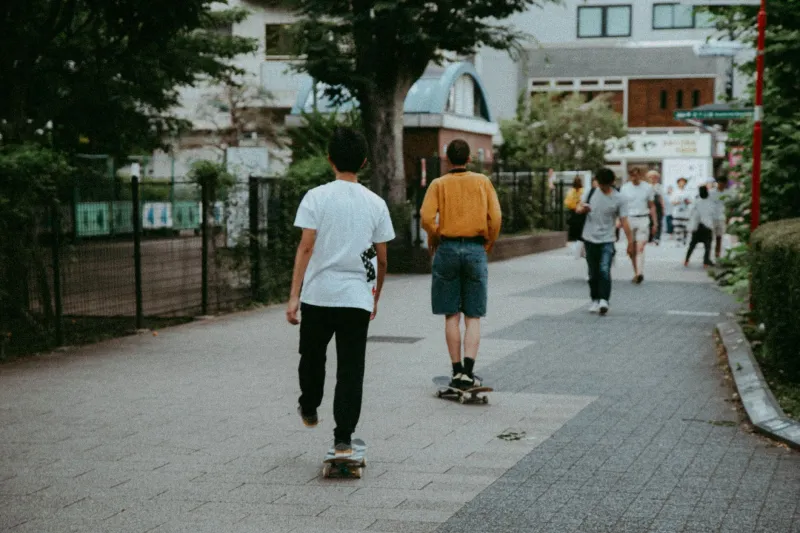
In Japan's street skate scene, finding a spot isn't treated as the warm-up act before the real session. The discovery process is part of the practice. There's a word that keeps surfacing in conversations with Japanese riders: sanpo, which loosely translates to a leisurely, purposeless walk. It's the opposite of a mission. You're not hunting. You're just moving through the city with open eyes.
Tokyo-based rider Yuta Mori describes it this way: "If I go out looking for a specific thing, I usually come home empty. But if I just walk with no plan, I find three things I wasn't expecting." That philosophy sounds almost too simple, but it maps onto something real about how creative attention works. The brain that's hunting locks onto patterns it already recognizes. The brain that's wandering sees everything.
American spot culture, by contrast, has been reshaped by the same efficiency logic that governs everything else in US consumer life. Why walk for two hours when you can search a geotag in two minutes? The answer, it turns out, is everything that happens in those two hours — the context, the community awareness, the feel of a neighborhood before you ever set a board down.
What the Algorithm Can't Tell You
Here's what a geotag doesn't include: the fact that the building's residents have already complained twice this year. The way the concrete gets slick after 4 PM when the sprinklers run. The local crew that's been sessioning that spot for five years and will absolutely not appreciate a pack of out-of-towners showing up with a camera drone.
Japanese skaters who scout slowly tend to arrive at spots with all of that information already loaded. They've talked to people in the neighborhood. They've returned at different times of day. They understand the social ecosystem around the concrete, not just the concrete itself.
Ryota Ishida, who skates in Nagoya and has spent time riding in Los Angeles, puts it plainly: "In America, I noticed people would find a spot and immediately want to film it. In Japan, you find a spot and you sit with it first. Maybe you don't skate it the first time you visit. That feels weird to Americans, but it makes the session better when you finally go."
That patience isn't just cultural politeness. It's tactically smart. Spots that get rushed tend to get burned fast. Spots that get scouted carefully tend to stay alive longer, because the people using them understand and respect the boundaries that keep them accessible.
The Seasonal Dimension
One thing that rarely enters American spot conversation is time of year. But ask a serious Japanese street skater about their favorite spot and they'll often qualify the answer with a season. This ledge is perfect in late autumn. That bank is better in spring before the tourists come back.
Seasonal awareness sounds like a minor detail until you realize how much it changes the actual skating. Concrete that's been through a hard winter has different texture than summer-baked asphalt. Shadows fall differently. Foot traffic patterns shift. The spot you visited in August is a different object in February.
Building seasonal knowledge into spot scouting is something Japanese riders do almost instinctively — partly because many of them have been visiting the same urban geography for years, watching it change. American skaters, especially in cities with high crew turnover and constant social media churn, rarely stick around long enough to develop that kind of longitudinal understanding.
What American Riders Are Starting to Figure Out
Some US riders are pushing back against the Instagram-to-session pipeline, and the shift is noticeable. In cities like Portland, Philadelphia, and Chicago, small crews have started adopting what one rider called a "no-post-first" rule — scouting and sessioning spots without documenting them publicly until they've had time to really work the location.
That's not a Japanese idea, exactly. But it rhymes with one. It's the recognition that speed of access doesn't equal quality of experience, and that a spot deserves more than a 24-hour content cycle.
The American skate scene has incredible energy, creativity, and a willingness to go hard that's genuinely its own thing. But the spot-rushing culture wastes a lot of that energy on locations that haven't been properly understood. A little sanpo philosophy — some purposeless walking, some patient return visits, some attention to the neighborhood rather than just the concrete — might be the cheapest upgrade available.
Kenji is still visiting that embankment in Osaka. He says he'll skate it when it feels right. Most American riders would've posted the clip and moved on two years ago. But Kenji's not in a hurry. He already knows the spot better than anyone else ever will.