The Parking Lot Dojo: How Japanese Flatland BMX Keeps Pulling Riders Back to Basics
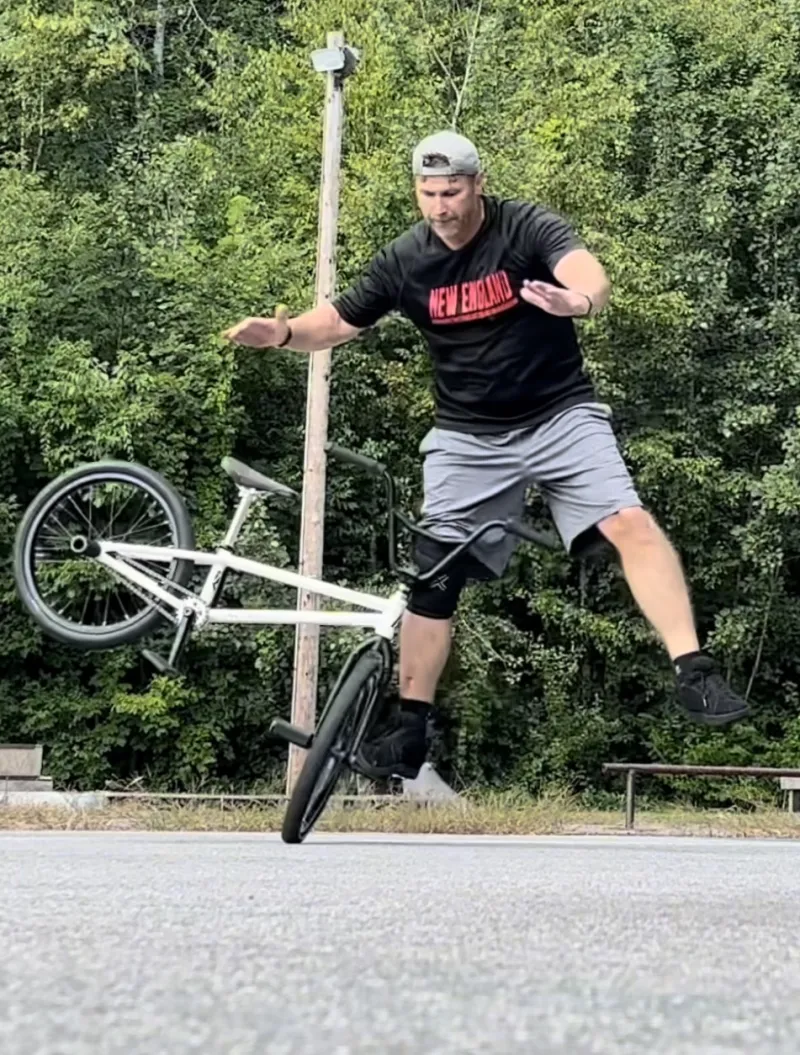
Photo: Mark McGrade, CC BY-SA 4.0, via Wikimedia Commons
Drive through almost any mid-sized Japanese city after 9 p.m. and you will find one eventually: a rider alone on a flat, empty slab of asphalt, spinning in a circle roughly the size of a parking space. No ramps. No rails. No phone tripod. Just a bike, a light, and a hundred repetitions of something that looks impossible and takes four seconds.
That is flatland BMX, and Japan has quietly become one of its most serious homes. For a generation of American riders raised on skateparks and street edits, the appeal is starting to make sense again.
A Discipline America Invented and Then Mostly Forgot
Flatland's roots are American. The freestyle boom of the 1980s produced it, the magazine covers of that era sold it, and then the sport drifted. Skateparks got built, street riding got the cameras, and flatland became the thing older riders did in driveways. It never died here. It just stopped being visible.
Japan took a different path. With limited park access, tight urban space, and a culture that has never treated small-scale repetition as a lesser form of practice, flatland found exactly the conditions it needed. A rider does not need a permit, a build crew, or a ride to the next town. They need twelve feet of level ground.
Repetition Is the Whole Sport
What separates the Japanese flatland scene from a casual driveway session is the relationship with repetition. A rider will work the same link for weeks. Not the same trick — the same transition between two tricks, the half-second where balance transfers from a rear wheel to a front wheel and everything either holds or falls apart.
Watch a serious session and you will notice the rhythm. Roll in slow, set up, fail, reset. Roll in slow, set up, get two degrees further, reset. Nobody is chasing a clip. Nobody is on a timer. The whole enterprise is built around the idea that a movement repeated a thousand times becomes something you own.
For American riders used to measuring progress in new tricks, that is a hard adjustment. Flatland rewards depth over variety. There are riders who have spent entire seasons on a single rolling combination, and they are not ashamed of it.
Small Space Is a Feature, Not a Limitation
Here is the part that surprises people who have never tried it: flatland does not want room. A bigger surface does not help. The best flatland riders work in a circle roughly the size of a hula hoop, and the discipline of that constraint is the point.
Parking lots are perfect. So are plaza corners, dead-end hardstands, the flat concrete outside a supermarket, a covered walkway after dark. The spot is not a stage. It is a floor. It can be boring, ugly, and completely devoid of skate value and still be a great flatland spot.
There is a practical consequence to this that American riders should pay attention to. Flatland can be practiced in places where skateboarding and street BMX cannot. That means more sessions per week, less travel, and no dependency on a park being open or a crew being available.
Why American Riders Are Circling Back
A few things are pushing the revival stateside. Bike setups have gotten friendlier — shorter frames, more standover clearance, easier gear ratios. Video access has improved, so the technical vocabulary is no longer locked behind a handful of DVDs. And there is a real fatigue with the park-and-street loop: twenty riders, one ledge, forty minutes of waiting.
Flatland offers the opposite. It is solo by default. It is portable. It costs nothing after you own the bike. And it produces a kind of progression that is measurable in inches rather than in new spots.
Riders who split their time between street and flatland often report that the flatland work sharpens everything else. Balance, brake control, body position, the ability to bail without panicking. All of it transfers.
How to Start Without a Park or a Crew
You do not need much, and you definitely do not need permission. A few practical notes:
Start with brakes. Rear brake first, both brakes if you are serious. Brakeless flatland is a later chapter, not chapter one.
Find a flat slab. Empty parking lot, school hardstand, tennis court, warehouse apron. Check for gravel, cracks, and drainage slopes. Ninety-nine percent of the difficulty is finding genuinely level ground.
Learn three moves before you learn thirty. A rolling endo, a trackstand variation, and a basic balance point on the rear wheel. Spend a month on those. Resist the urge to move on.
Short sessions, high frequency. Twenty minutes a day beats three hours on Saturday. Flatland is a neuromuscular skill, and it responds to frequency far more than volume.
Film yourself from a fixed position. A phone against a water bottle is fine. You cannot feel what you cannot see, and most of the corrections happen in a five-inch range of body position.
Do not chase parts. The Japanese scene is not a gear culture. Riders show up on older bikes and ride them into the ground. Spend your money on tires and time.
The Dojo Never Closes
What makes the Japanese flatland underground worth studying is not that the riding is exotic. It is that the scene built its entire culture around the constraint most American riders treat as an excuse: not enough space, not enough time, nobody to ride with.
A parking lot at night is enough. That is the whole lesson. Flatland is not dead, and it was never really about equipment or locations. It is about a flat piece of ground, a hundred repetitions, and the willingness to be bad at something in public for a very long time.