City as Skatepark: How Tokyo's Street Hunters Decode Urban Geometry—And What American Riders Are Missing
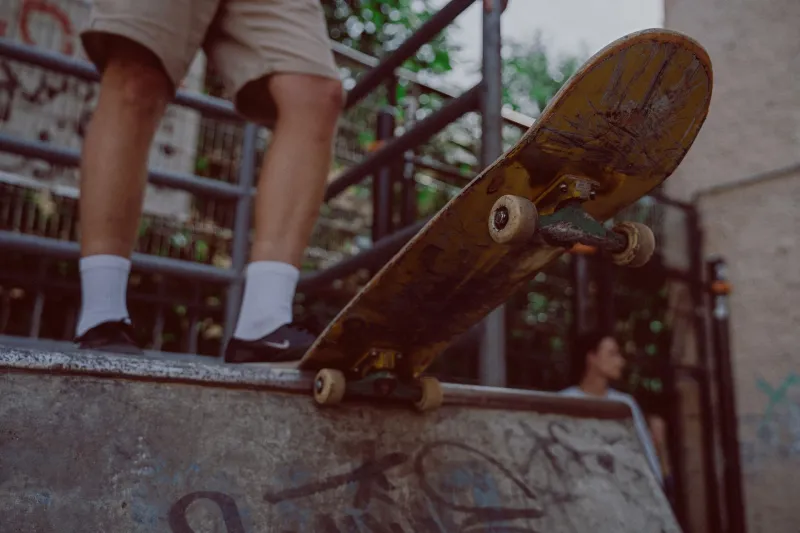
Most riders go looking for spots. Tokyo's best street hunters go looking for geometry.
There's a difference. A casual spot-finder walks around hoping something jumps out—a ledge here, a gap there. A terrain archaeologist, which is the best way to describe what serious Japanese street skaters and BMX riders actually do, moves through a city with a completely different set of eyes. They're not waiting for something obvious. They're reading angles, measuring shadow lines, calculating how water runoff shapes concrete, noticing where municipal workers accidentally created a perfect transition while patching a sidewalk crack.
That skill—call it urban geometry literacy—is one of the most quietly influential exports coming out of Japanese street culture right now. And American riders are only just starting to catch on.
Why Tokyo Produces Better Spot Hunters
Here's the thing about Tokyo: it's dense. Wildly, almost incomprehensibly dense. When you're operating in a city where every square meter of public space is contested, you either develop the ability to find creative potential in tight, overlooked corners, or you don't skate street at all.
American cities—even the crowded ones—tend to sprawl. There's usually another block, another parking lot, another obvious plaza to check. That abundance, paradoxically, makes American riders lazier observers. Why develop a refined eye when there's always somewhere bigger and more obvious just down the road?
Japanese riders don't have that luxury. A Tokyo street session might hinge on a single concrete planter base in a pedestrian corridor that's only usable for forty minutes before foot traffic makes it impossible. You find it or you don't skate. That pressure forged a culture of genuinely systematic urban observation that most American riders have never had reason to develop.
The Three-Layer Scan
Spot scouting in Japanese street culture isn't a random walk. Riders who are serious about it—and plenty are deeply serious—tend to approach new environments in what you could loosely call a three-layer scan.
Layer one is macro. Before you ever step off your board or bike, you're reading the neighborhood's skeleton. What's the general construction era? Older Japanese concrete from the 1960s and '70s tends to be rough and uneven, but the angles on plazas from that period are often more dramatic and skateable than modern civic design, which prioritizes accessibility ramps that, conveniently, also make excellent transitions. In American terms, think about how differently a mid-century Rust Belt downtown reads versus a freshly developed Sun Belt suburb. The bones tell you what to expect before you get close.
Layer two is structural. Now you're looking at individual elements—but not the obvious ones. Japanese spot hunters are specifically trained (informally, through sessions and mentorship) to ignore what a space was designed to do and focus on what its geometry actually does. A loading dock isn't a loading dock. It's a potential manual pad with a built-in drop. A decorative concrete barrier isn't an obstacle. It's a question about whether the cap is waxable and what angle the approach runs. You're mentally stripping the function out of every object and replacing it with pure shape.
Layer three is surface and condition. This is where a lot of American riders start and stop—they check if the ground is smooth and move on. Japanese riders go deeper. They're looking at how concrete has cured, where aggregate has worn through to create grip, whether a marble ledge has the right density to hold wax without flaking, how afternoon sun dries a surface that was damp in the morning. Seasonal awareness matters too. A spot that's borderline in February might be perfect in May simply because the concrete has had more sun exposure and the surface texture has changed.
Transferring the Method to American Cities
The good news is that this isn't some mystical untranslatable skill. It's observational practice, and practice can be learned.
Start with cities that American skate culture has historically underrated. Pittsburgh, Cincinnati, Providence, Spokane—places that developed before modern accessibility codes standardized civic architecture into something blander and more uniform. The older the urban core, the more geometric variety you're likely to find. These cities have layers of construction and renovation stacked on top of each other, which means unexpected angles, mismatched surface heights, and transitions that were never intended as skateable features but absolutely are.
Walk before you ride. This sounds basic, but most American riders pull up to a spot, drop in, and start trying things immediately. Japanese spot hunters frequently spend as much time walking a new area on foot as they do actually skating it. You see things differently at walking pace. You notice the subtle camber on a bank, the way a wall's base flares slightly outward, the quarter-inch lip on a ledge that makes it waxable versus the flush-mounted version that won't hold anything.
Shoot the geometry, not the trick. Another habit worth stealing: serious Japanese street scouts photograph environments systematically before sessions, capturing angles and structural details rather than just aesthetic shots. When you review those images later, you often spot potential you missed in person because you were too focused on the obvious features. This is especially useful in American downtowns where security presence makes extended scouting uncomfortable—you can do a quick pass, document everything, and analyze it somewhere else.
The Unexpected Payoff
Here's what nobody tells you about developing this kind of observational discipline: it doesn't just help you find spots. It changes how you skate.
Riders who've internalized terrain literacy start approaching known spots differently. They notice lines they'd been skating past for years. They find transitions within transitions—a bank that most people treat as a single surface actually has a subtle change in pitch two-thirds of the way up that creates a natural launch point if you weight it correctly. The city stops being a fixed backdrop and becomes something more dynamic, more readable, more responsive.
That's the real output of what Tokyo's street hunters have developed over decades of necessity. Not just a list of spots. A way of seeing.
American street skating has always had raw energy and creativity going for it. Add this kind of systematic eye to that foundation and the combination gets genuinely interesting. Some of the most exciting street content coming out of places like Detroit, Baltimore, and Albuquerque right now reflects exactly that synthesis—riders who grew up with American skate culture's freewheeling approach but picked up the observational rigor that Japanese street hunting demands.
The city's been talking this whole time. Most of us just weren't listening closely enough.
Go slower. Look harder. The geometry's already there.