Lost in Translation, Found in Motion: How Japanese Skate Coaching Is Rewiring the American Learning Curve
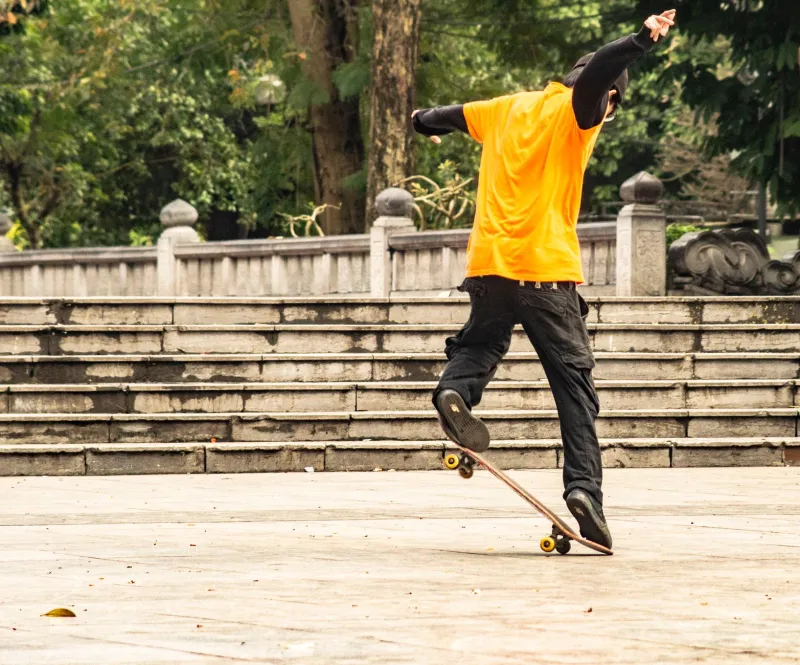
There's a moment every American skater hits when they first drop into a Japanese tutorial video. The instructor is calm, deliberate, almost meditative. There's no hype, no "bro you got this," no rapid-fire verbal breakdown of every micro-movement. Just a body moving through space with surgical precision, repeated from multiple angles, sometimes in near silence.
And somehow — despite not understanding a single word — the trick starts to click.
That's not a coincidence. It's a philosophy.
The Noise Problem in American Skate Instruction
American skate culture has always been loud. Not just in terms of music and attitude, but in how knowledge gets passed down. The typical US skate lesson — whether it's a YouTube breakdown or a session with an older homie at the park — leans heavily on verbal instruction. "Pop harder." "Catch it with your front foot." "You're leaning too far back." Words, words, words.
The problem is that skateboarding is fundamentally a physical language, and translating it into spoken English introduces a layer of abstraction that can actually slow down learning. You start thinking instead of feeling. Your brain is processing instructions while your body is supposed to be reacting.
Japanese skate coaching has largely avoided this trap — not through any single pedagogical decision, but through a broader cultural orientation toward learning through observation and embodied repetition.
"I watched this Japanese guy on YouTube break down a heelflip for like eight minutes and he barely said anything," says Marcus Webb, a 24-year-old skater from Phoenix who's been skating for nine years. "He just kept showing the foot position from different angles, super slow, and then full speed. I'd been trying to fix my heelflip for months. After watching that video twice, I landed it clean the next session."
Body First, Words Later
At the core of Japanese skate instruction is a concept that doesn't have a clean English equivalent but roughly translates to "learning through form." The body is treated as the primary instrument of understanding. Before a student can talk about a trick, they need to have felt it — or at least felt the component movements that build toward it.
This shows up in a few distinct ways.
First, there's an emphasis on static positioning. Japanese tutorials frequently pause to isolate foot placement, shoulder alignment, and hip rotation as standalone elements before combining them into a moving trick. American instruction tends to jump straight to the full motion, treating the setup as a quick aside before the "real" instruction begins.
Second, Japanese coaches — both online and in person — rely heavily on mirroring. Students are encouraged to watch and copy physical form before they're given any verbal framework for what they're doing. The body learns the shape first. The explanation comes after, if it comes at all.
Third, and maybe most importantly, there's a cultural comfort with productive silence. In an American skate session, silence often reads as disengagement or frustration. In Japanese coaching contexts, silence during observation is a sign of respect and focus. You're not expected to fill the air with commentary. You're expected to watch.
The Language Barrier as an Accidental Feature
Here's where things get interesting. American skaters who've immersed themselves in Japanese tutorial content — without speaking a word of Japanese — report that the language barrier itself may be part of why it works.
"When I can't understand what someone's saying, I'm forced to actually look at what they're doing," explains Dani Reyes, a 19-year-old skater from San Diego who discovered a Japanese skating channel through Instagram. "In English tutorials I'm half-listening, half-watching. With Japanese ones, I'm just watching. My whole attention goes to the movement."
This is essentially accidental sensory prioritization. Strip away the verbal channel and the visual one gets louder. You start noticing things — the angle of a wrist, the timing of a shoulder drop, the way weight shifts from heel to ball of foot — that would have been drowned out by narration.
Some American coaches are starting to take note. A handful of skate instructors in cities with significant Japanese-American communities, particularly in LA and the Bay Area, have begun incorporating observation-first methods into their sessions, deliberately holding off on verbal explanation until students have had time to simply watch and attempt.
What Specific Techniques Are Crossing Over
Beyond general philosophy, certain specific approaches from Japanese skate instruction are gaining traction in American communities.
Slow-motion form drilling — breaking a trick into its slowest possible execution to isolate body mechanics — has become increasingly common in US skate content, particularly on platforms like TikTok and Instagram Reels where short-form video forces creators to communicate efficiently.
Angle multiplicity — showing the same trick from front, side, and behind without cutting away — is another technique American creators are borrowing. It respects the viewer's intelligence and trusts them to synthesize the information visually rather than having it explained.
There's also growing appreciation for what you might call negative space instruction: Japanese tutorials often spend significant time showing what not to do, presenting common errors with the same care and detail as the correct form. American instruction tends to minimize failure, keeping the focus on the successful execution. Japanese instructors treat the mistake as equally educational.
The Bigger Picture
What's happening here isn't just a trend in tutorial content. It's a slow-moving collision between two distinct learning cultures — one that prizes verbal articulation and individual expression, and one that values embodied knowledge and collective refinement.
American skaters are notoriously resistant to formal instruction. The whole ethos of street skating is self-taught, earned through slams and persistence. But there's a difference between formal instruction and better instruction, and the Japanese approach doesn't feel like a classroom. It feels like watching a master at work and letting your body take notes.
Marcus Webb puts it simply: "It's not that the Japanese way is easier. It's that it gets out of its own way. You're not fighting the words to get to the movement. You just get to the movement."
For American riders willing to sit with the discomfort of not understanding everything immediately, that's not a barrier. That's the lesson.