Beyond the Limit: What Japanese Riders Know About 'Impossible' Tricks That American Training Manuals Don't
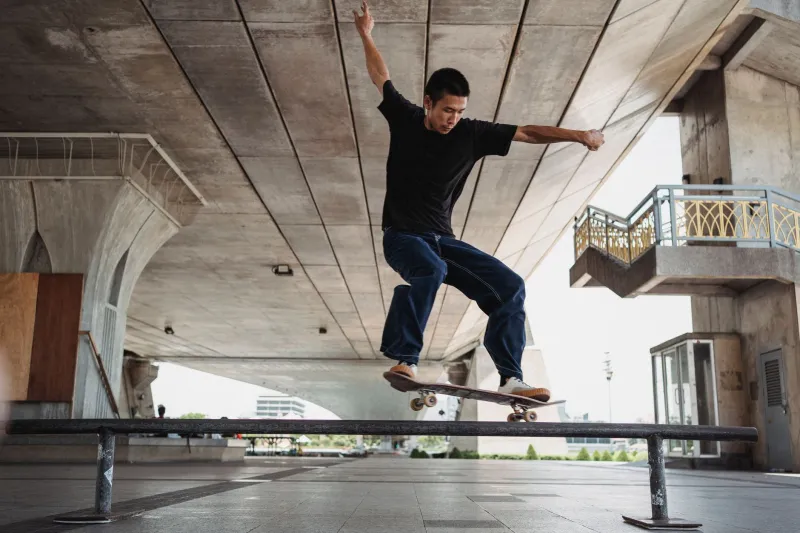
There's a clip that's been floating around private group chats in the American skate community for about six months. It shows a nineteen-year-old from Osaka — no sponsor tags, no hype reel intro — landing a switch heelflip nosegrind revert on a kinked rail that most US pros would walk away from without even kicking their board at it. The comments are split between disbelief and the kind of quiet respect that doesn't need exclamation points.
This isn't a one-off. It's a pattern. And if you've spent any real time around Japanese freestyle culture, you already know the pattern by name.
The Failure Economy
Here's the core disconnect. In mainstream American skate coaching — especially in the structured, academy-style programs that have multiplied since skateboarding hit the Olympics — failure is something to be minimized. Sessions are designed around achievable milestones. Coaches track success rates. Progression is mapped like a school curriculum, with prerequisites and checkboxes.
In Japan, failure is treated like raw material.
Chris Valdez, a 26-year-old skater from Phoenix who spent four months training with a crew in Osaka, put it plainly: "I'd been skating for twelve years and I thought I understood how to practice. Then I watched these guys spend an entire Saturday on a single trick — not even close to landing it — and come back Monday acting like they'd won something. It rewired my brain."
The Japanese concept of kaizen — continuous, incremental improvement — gets thrown around a lot in Western productivity circles, but its application in athletic training runs deeper than most outsiders realize. The goal isn't to land the trick by the end of the session. The goal is to understand the trick more completely than you did when you showed up. Landing is a byproduct, not the target.
Body Mechanics, Reframed
American coaching orthodoxy around trick biomechanics tends to work from the outside in. You watch the trick, you break it into phases, you drill each phase. It's logical. It's also, according to several riders who've trained in both systems, kind of limiting.
Japanese coaches — particularly in the BMX flatland scene, which has always operated as its own universe of technical obsession — tend to work from the inside out. The question isn't "what does this trick look like?" It's "what does your body need to understand before this trick becomes possible?"
Dylan Mercer, a BMX rider from Columbus who spent two weeks at a flatland workshop in Nagoya, described a drill that had no American equivalent in his experience. "They had me doing this balance exercise that looked completely unrelated to the trick I was trying to learn. I thought it was warmup. Turns out they were building a proprioceptive foundation — training my nervous system to recognize weight distribution at a granular level I'd never accessed before. Three days later, I landed something I'd been trying for eight months."
The biomechanical philosophy at play here borrows from Japanese martial arts traditions that emphasize mushin — a mental state of no-mind, where movement flows without conscious interference. American training often does the opposite: it makes riders hyper-conscious of each micro-movement, which can create hesitation at exactly the moment when commitment is everything.
The Practice Structure Nobody Talks About
Spend a session at a serious skate spot in Tokyo or Osaka and you'll notice something that feels almost counterintuitive to American eyes. Riders aren't always going hard. There are long pauses. People sit and watch — not their phones, the spot. They're reading architecture, reading physics, reading possibility.
This deliberate observation period is baked into Japanese training culture in ways that don't have a clean American translation. It's not laziness and it's not fear. It's reconnaissance. Riders are building a mental model of the trick before the body ever commits.
Jessica Tran, a 23-year-old skater from San Diego who documented her time riding with a women's crew in Sapporo for a self-produced video project, noticed this immediately. "Back home, the vibe is always 'go, go, go.' You're supposed to look fearless. In Sapporo, the most respected skaters were the ones who could sit still the longest before they dropped in. That stillness wasn't passive — it was loaded."
The result of this approach is a different relationship with risk. American skate culture often frames risk as something to push through, a mental barrier to be charged at. In Japan, risk is something to be understood until it becomes manageable. The trick doesn't get attempted until the rider has, on some level, already landed it in their mind.
What American Riders Are Bringing Home
The interesting thing is that the knowledge transfer is happening organically. American riders who've trained in Japan aren't coming back with Japanese coaching certifications or formal methodology documents. They're coming back changed in ways that are hard to articulate but easy to see in their footage.
Valdez started running what he calls "observation sessions" with his Phoenix crew — fifteen minutes at a new spot before anyone touches their board. "People thought I was being weird at first. Now it's just what we do. Our trick progression has gone up significantly and I genuinely think it's connected."
Mercer integrated balance-specific drills into his pre-session warmup and started keeping a notebook — not of tricks he wants to learn, but of sensations he wants to understand. "It sounds soft but it's the most technical thing I've ever done."
None of this means American training is broken. The US produces world-class riders on a massive scale and the competition infrastructure here is genuinely elite. But there's a ceiling that some riders are hitting, and the people who've gone to Japan are coming back with tools to push through it.
The tricks American coaches call impossible aren't impossible. They're just asking questions that American training hasn't learned to answer yet.
Japan's been answering them for a while.